 |
 |
 |
|
        |
|||
 |
|||
 |
 |
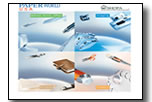
WinRrich attend Paperwolrd 2012
on this largest wolrd stationery exhibition Winrich will show its all new 2012 products for buyers. Our booth is 4.1 Hall 19
  |
 |
 |
|||
|
New 2012 products catalogue is online active now
difficult to find new products idea? whyn't to view Winrich 2012 products catalogue
 |
||
|
|||
|
Meet Winrich on Paperworld 2012..
for all buyers , meet us on Frankfurt, 30 January - 2 February, 2012
 |
||
|
|||
|
Value added service... is to realize a service platform with all the projects, not only the products, but also...
 |
||
|
|||
|
Winrich iCommunication coming soon...online communication with us for tracking your orders in 24 hours, forget any timedefferency...
 |
||
|
|||
|
|||
 |
|||
|
|
|||
Let's begain... |
|||
 |
Winrich Pencils |
||
Your one stop for pencils and pencil accessories. Whether you need high quality artist drawing and water color pencils, graphite writing or children's coloring pencils, our Winrich range covers professional, school, home and office use. |
|||
How many type of pencils have we? |
|||
Wooden pencils: The most common of all pencils are the wood-encased types. A thin rod of a graphite composite or other material is sandwiched between two precisely formed strips of wood. An illustration of the steps involved in making wood pencils can be found here. Wood pencils are usually made with cedar because it can withstand the tortures of sharpening and stresses of writing without cracking or splitting. Wood pencils are most commonly hexagonal or rounded in shape, but some types may be triangular, octagonal, or otherwise. Some specialized pencils, such as carpenter's pencils, artists' pencils, etc. may be flat or elliptical in shape. |
|||
Woodenfree pencils: With increased awareness of environmental issues, Winrich is now producing "Holly" pencils made from recycled materials, such as plastics, cloth, sawdust, paper and others. These pencils usually resembled wood-encased pencils and are comparable in quality to their wood counterparts. |
|||
Mechanical pencils: Winrich Mechanical pencils come in many styles. Generally speaking, mechanical pencils consist of an engineered case made from metal, plastic, or a combination of both. The case contains an internal mechanism for advancing a thin, replaceable shaft of lead, which is actuated by twisting, pressing, or clicking some external gadget. Considerable design effort has gone into many of today's precision mechanical pencils. Please check our mechanical pencils catalogue. |
|||
|
Winrich Pencil Manufacturing Process |
||
Making process for pencils lead |
|||
     |
|||
    |
|||
Making process for wood & pencil |
|||
 |
|||
1. Incense-cedar logs are cut into "Pencil Blocks." |
|||
2. Pencil Blocks are cut into "Pencil Slats." |
|||
3. Pencil Slats are treated with wax and stain. |
|||
4. A machine cuts grooves into the slats to accept the lead. |
|||
5. Writing cores -- made from a mixture of graphite and clay -- are placed into the grooves. |
|||
6. A second grooved slat is glued onto the first -- making a "sandwich." |
|||
7. The sandwich is machined into pencil shapes. |
|||
8. Individual pencils are cut from the sandwich, and are sanded smooth. |
|||
9. Each pencil is painted. A recess is cut to accept the ferrule (the metal ring that holds the eraser to the pencil). |
|||
10. A ferrule and eraser are crimped into place on each pencil. |
|||
|
Why are pencils yellow? |
||
Pencils have been painted yellow ever since the 1890s. And that bright color isn't just so you can find them on your desk more easily! During the 1800s, the best graphite in the world came from China. American pencil makers wanted a special way to tell people that their pencils contained Chinese graphite. In China, the color yellow is associated with royalty and respect. American pencil manufacturers began painting their pencils bright yellow to communicate this "regal" feeling and association with China. The rest, as they say, is history. Today, 75% of the pencils sold in the United States are painted yellow! |
|||
|
Where does wood comes from for pencil? |
||
To ensure the continued availability of Incense-cedar, forest workers have carefully managed the stands of trees in which Incense-cedar grows, and timber companies have been careful to harvest the trees on a sustained-yield basis. "Sustained-yield" means that the annual growth of the forest is greater than the amount harvested from the forest. Forests managed on a sustained-yield basis are abundant and healthy, and will continue to provide wood for people and habitat for animals for generations to come. Winrich uses Chinese Linden wood, Piny wood and American Cedar wood for pencil. |
|||
|
Winrich Pencil Lead |
||
The center of the pencil -- known as the writing core "lead" -- is made of a nontoxic mineral called graphite.
Today's writing cores are a mixture of graphite and clay.
By varying the ratio of graphite to clay, pencil makers can adjust the "hardness" of the writing core.
The hardness of the core is often marked on the pencil -- look for a number (such as "2" or "3"). The higher the number the harder the writing core. You might see other markings on pencils. Some pencil manufacturers use the letter "H" to indicate a hard pencil. Likewise, a pencil maker might use the letter "B" to designate the blackness of the pencil's mark. The letter "F" is also used to indicate that the pencil sharpens to a fine pont.
Pencil makers also use combinations of letters -- a pencil marked "HB" is hard and black; a pencil marked "HH" is very hard, and a pencil marked "HHBBB" is very hard and really, really black!
|
|||
 |
How to apart pencils? |
||
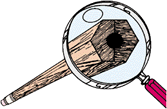
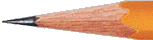
Pencils made from Incense-cedar (a renewable resource) are a reddish brown inside with a smooth, fine grain and a visible seam. They also have that familiar cedar scent when sharpened! |
|||
  |
|||
Pencils made from tropical rainforest wood have a brownish color with little dark brown or red flecks. It is very hard to see the grain, and they have a slight scent |
|||
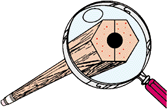  |
|||
Pencils made from plastic have a pinkish color with no grain or seam, because plastic composite pencils are extruded by machine. They bend easily, and snap cleanly when broken. They do not have a scent. |
|||
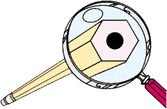 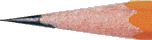 |
|||
|
Winrich pencil Specs |
||
 |
|||
|
 |
||
|
Pencil stamping specs: |
||
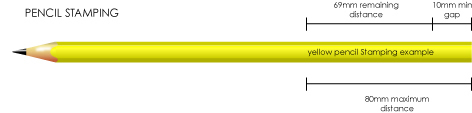 |
|||


 |

 Copyright 2003, WinRichStationery.com Copyright 2003, WinRichStationery.com |
Home|Site map|About us|Products|Services|Jobs|World|Contact us |
